Shame and Sweetness
Last night I watched Sweet Charity and found myself unexpectedly undone. What I thought would be a distraction from the present moment ended up breaking it open.
As I see every day in my practice, shame is not just a personal feeling; it is a social technology. It evolved to keep us inside the circle: be acceptable, or be alone. In small doses it may hold societies together. In large ones, it splits people from themselves.
Sweet Charity shows this with devastating clarity.
Three words can be yours.
Clarity. Courage. Commitment.
Click here to sign up for a 90 Minute Breakthrough Session with Angie
Charity, a sex worker, is radiant. In her community of dancers and coworkers, she has humor, joy, and belonging. But Oscar, the man who falls in love with her, doesn’t know her in that world. He loves her because he doesn’t know her—because he can imagine her as “pure.”
When she tells him the truth, he thinks he can accept it as long as it is never spoken again. If it stays buried, his disgust won’t get triggered.
Bob Fosse stages this with surgical precision. The lovers suddenly can’t look at each other. Their bodies turn away. Their eyes avert. Shame takes physical form between them. Charity’s shame only appears when she wants to be loved by a man who carries the culture’s judgment inside him.
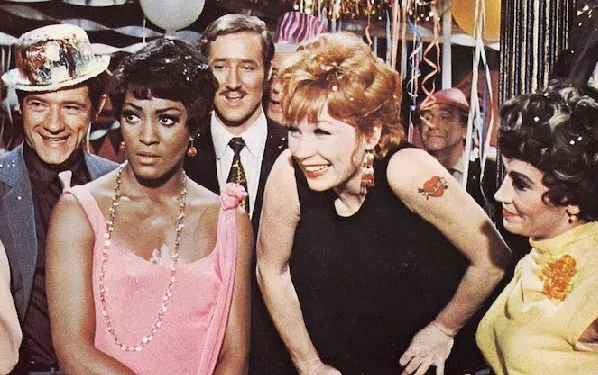
And then we see something even more unsettling: when her friends celebrate her engagement, Charity belongs. She is not humiliated there. She is whole. And something in Oscar recoils—not because she is unworthy, but because she is too intact.
This is why their love is not the tragedy it first appears to be. By the end, we don’t actually want Charity to end up with Oscar, because his moral world would require her to be ashamed in order to be lovable.
We want her to choose her life. To be unburdened. To exist without needing to disappear in order to be loved.
We are not shaped only by our families, but by the stories of our time—about purity, goodness, worth, and disgust—written into our bodies long before we have language.
Which is why healing is never just personal. It is also historical. Charity doesn’t need to be rescued by a man. She needs to belong to herself without shame.
And so do we.
As Charity says, “I’m nuts about happy endings.”
I want one for all of us.
With love,

P.S. Are you interested in diving deep and learning about the different parts of you? Click here to sign up for a 90 Minute Breakthrough Session with me.
