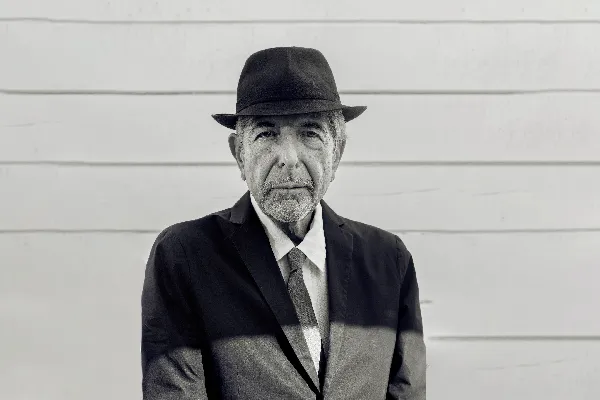
Punk Rockers Loved Leonard Cohen
Many of us are managing some level of despair right now. For some of my clients, it shows up as anger. For others, grief. Others still are holding a fragile kind of hope that flickers in and out, depending on the day, or the news cycle.
Most of us are carrying some combination of all three.
When the world feels chaotic, steadiness can be elusive. There’s no solid, quiet ground outside the global polycrisis. Sometimes, even when we clear a bit of space for peace, guilt sets in that we should head back to the fight.
In the midst of all this, I’ve been thinking about Leonard Cohen.
Punk rockers, those glorious poets of anger and darkness, have always loved Leonard Cohen. They love him because Cohen never pretended the world was simple or harmonious. He didn’t smooth over conflict or give cheap resolutions. Instead, he told the truth about human contradiction: spirituality mixed with cynicism, devotion braided with sarcasm, longing right alongside despair.
Cohen didn’t present himself as a moral authority. He once described himself as a “lazy man” and a “secretly vain man.” He understood that struggle—internal and external—is built into the human story.
And he wrote about it honestly.
I first fell in love with Leonard Cohen when I was a kibbutznik in Israel in 1986. By that time, many of the young people on the kibbutz were already a little more cynical than their parents.
The founding generation had built those communities on enormous idealism: collective living, shared purpose, the belief that society could be rebuilt in a more just way.
If you’re holding a lot...
...and would like a steady place to talk it through, I offer a free 25-minute call. No pressure, just a chance to meet and see what support might feel helpful.
Book a 25-minute Call with Angie
By the mid-1980s, my generation was living inside those structures but seeing the cracks. We still cared deeply—but the innocence was gone.
Cohen’s music fit that moment perfectly. One song that has always stayed with me is There Is a War.
It isn’t patriotic or triumphant. Instead, it quietly explores humanity’s strange attachment to conflict:
There is a war between the rich and poor
A war between the man and the woman
There is a war between the ones who say there is a war
And the ones who say there isn’t.
And then Cohen adds a line that sounds like a smirk:
Why don’t you come on back to the war?
That’s right, get in it.
Anyone who’s heard the song knows, of course, that it is not a call to battle, but an observation. We say we want peace, but something in us keeps pulling us back to war—ideological, political, personal.
Listening to it now, I hear it differently than I did at eighteen. We are living through a moment charged with conflict—global, political, and often familial or inside communities. It can be painful to watch narratives coalesce in which bullies present themselves as heroes while the steady courage people actually need becomes harder to recognize.
It’s not surprising that despair shows up. Or anger. Or exhaustion.
What Leonard Cohen offers me in moments like this is not resolution, but honesty. His dry humor about humanity’s endless wars doesn’t erase the pain. But it creates just enough distance to breathe. A little perspective. A small crack of irony that reminds me we are not the first generation to struggle with these tensions.
Cohen understood that faith doesn’t require pretending the darkness isn’t there. When the world feels especially heavy, I return to his music. It reminds me that despair, anger, and hope can all live in the same human heart—and that sometimes a little irony and sarcasm about the full catastrophe is exactly what helps us keep going.
With love,

P.S. If you’ve been noticing inner conflict, numbness, anger, or a fragile kind of hope, we can explore what’s happening with real gentleness. If you want, here’s a free 25-minute Discovery Call:
